


If 2025 was the year we started experimenting with AI, 2026 will be the year AI decides who wins the search engine race. We are moving away from traditional ‘blue link’ rankings toward an AI-first search strategy where visibility is no longer guaranteed by keywords alone. If your technical foundation isn’t built for this new era, your brand might become invisible.
Table of Contents
ToggleIs your site ready for the shift? Before you dive into the trends, use our Free SEO Analyzer to get a real-time audit of your site’s current health and see where you stand for SEO Trends 2025 vs 2026.
Key Takeaways: SEO Trends 2025 vs 2026
- The Trust Economy: Google is shifting to Helpful + Trusted Content. Your reputation is now a ranking factor.
- Topical Clusters: TOFU (Top of Funnel) content is no longer about clicks—it’s about feeding the AI “Entity” engine.
- Precision Over Length: The 3,000-word “long-form” era is ending. Short and precise content optimization is the new gold standard.
- Human Signals: Search engines are rewarding User-Generated Content (UGC) to combat the flood of AI-generated content.
- From Assistant to Architect: AI moves from a support role to the core architect of the search journey.
Does your site hit these 5 benchmarks? Run our SEO Analyzer to find out!
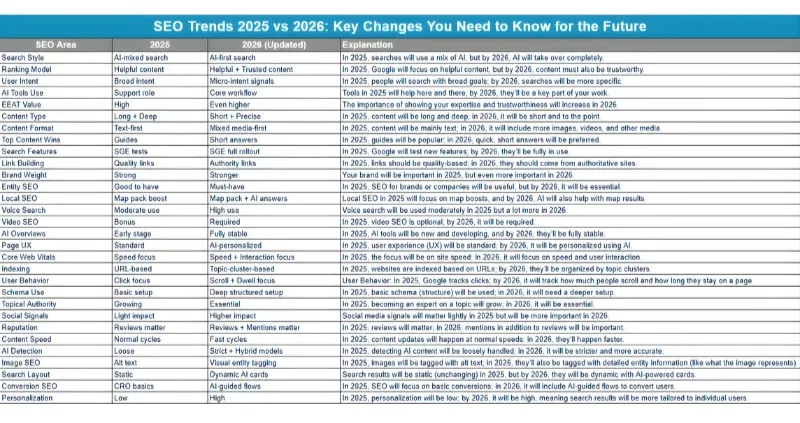
The Quick Glance: SEO Trends 2025 vs 2026 Comparison Table
Understanding the shift to an AI-first search strategy requires looking at how the “rules of the game” are changing year-over-year. As the SGE full rollout continues to prioritize AI Overviews over traditional blue links, the way we measure visibility must evolve.
In 2025, we are still balancing a mix of human and machine-driven search style. However, by 2026, search engines will rely almost exclusively on micro-intent signals to deliver personalized results. This means your technical foundation must be flawless. At Floating Chip, our Digital Marketing Services bridge this gap, helping you transition from 2025’s “helpful content” focus to 2026’s “trusted authority” requirements.
Trend 1: From “Content is King” to “Trust is Everything”

This is why forward-thinking companies are already searching for the Top 10 AI SEO Agencies in 2026. For over a decade, the mantra was “Content is King.”
In 2026, the King is dead. The focus has shifted entirely toward the Trust Economy.
It is no longer enough to produce “helpful content.” Your brand must provide Helpful + Trusted content that search engines can verify.
This evolution is driven by a massive increase in E-E-A-T value (Experience, Expertise, Authoritativeness, and Trustworthiness). In an AI-saturated world, Google and other LLM for business use Brand Weight and brand mentions to separate real experts from AI-generated noise.
They want to build a legacy of authority, not just a library of blog posts. To survive, you must master Entity SEO. Understanding How to Optimize Content for LLM SEO is critical. AI models don’t just “read” your text—they look for your Topical Authority across the entire web.
Ultimately, the new gold standard is learning to rank on Google AI Overviews.
E-E-A-T Ranking Factors for 2026
As we move into 2026, the standard for E-E-A-T (Experience, Expertise, Authoritativeness, and Trustworthiness) has evolved from a “quality guideline” to a hard ranking requirement. Google’s algorithms are no longer just looking for well-written text; they are hunting for verified human signals.
In the age of AI-saturated search results, the “T” in E-E-A-T—Trust—is the ultimate differentiator. Search engines in 2026 prioritize brands that have a clear, verifiable footprint. This means your authorship must be transparent, your data must be original, and your brand must be mentioned as a trusted authority across the web (social media, podcasts, and third-party news sites). If your content looks like generic “AI slop,” it will be bypassed by the AI Overviews in favor of experts with “lived experience.”
Don’t leave your authority to chance.
To help you navigate these stricter requirements, we’ve developed a specialized blueprint to ensure your site passes the 2026 trust test.
Get a step-by-step guide to verifying your authors, building brand social proof, and securing the “trusted source” status that AI assistants crave.
Trend 2: Why Topical SEO Clusters are the New “Top of Funnel”
Historically, we measured Top-of-the-Funnel (TOFU) content by Clicks. In 2026, TOFU is measured by “Share of Model.”
As Brian Dean (Backlinko) points out, the goal of informational content is shifting. You aren’t just trying to get a click; you are trying to build a Topic Cluster that tells the AI: “I own this subject.”
- The Logic: If you have 50 high-quality, precise posts about “Digital Marketing Audit,” AI models will cite you as the primary entity.
- The Metric: We are moving away from URL-based indexing toward Topic cluster indexing.
By building these clusters and following the topical authority strategy 2026, you feed the AI the data it needs to recommend your brand in a personalized search journey.
Trend 3: The Death of the “Long-Form” Obsession
The era of 2,000-word filler is officially over.
As AI takes over the Search Layout with Dynamic AI search cards, users want Short + Precise content.
This is driven by micro-intent signals.
Instead of broad keywords, AI assistants now look for the fastest, most accurate answer. If your answer is buried in fluff, AI agents will bypass your site.
When considering The Future of SEO, we must accept a new reality and top SEO trends:
- The metric for success is no longer just a “Click.”
- We are moving into an era of Scroll + Dwell focus.
To adapt, websites must deliver “short answers” that satisfy complex queries. This ensures you remain the primary source for AI-generated summaries.
Trend 4: Search Engines Will Reward User-Generated Content (UGC)
As the web becomes flooded with “AI slop,” search engines are desperate for Human Signals.
According to Exploding Topics, Google is increasingly prioritizing User-Based Search content from Reddit, Quora, and niche forums.
Why? Because humans trust humans.
- Social Signals Impact on Ranking: AI architects use real-time social engagement to verify if a brand is still relevant.
- Brand Mentions vs. Backlinks: A mention in a Reddit thread often carries more weight for Brand Weight in SEO than a generic backlink.
To prepare, you must integrate community voices and “lived experience” into your content strategy.
Trend 5: AI: From Assistant to Architect


In 2025, AI was a “support role.” By 2026, it will be the core architect. Search engines no longer just provide links; they construct an AI-personalized user experience.
Static results are replaced by Dynamic AI search cards. Optimizing for AI Overviews is now your primary goal. While many still focus on the importance of backlinks in SEO, the “architect” era prioritizes a topical authority strategy for 2026.
This is one of the most significant modern digital marketing trends. It requires deep structured data setup and interaction-focused Core Web Vitals to ensure AI can properly crawl and recommend your brand.
Trend 6: Technical SEO: Beyond the URL
Technical SEO is no longer just about fixing 404 errors. It is the bridge to AI discovery. To maintain visibility, brands must move beyond a standard crawl and implement a local seo audit checklist that ensures location-based entities are clearly defined for AI reasoning engines – where the integration of Human + Agentic AI ensures that site architecture is optimized for both crawlers and LLM reasoning engines.
It is the bridge to AI discovery.
You need a comprehensive SEO Audit Checklist that prioritizes:
- Entity-based SEO strategy: Evaluating your site as a singular “entity.”
- Voice search optimization trends: Optimizing for natural language.
- Interaction-focused Core Web Vitals: Instant response to user engagement.
For local businesses, the “Map Pack” is evolving into Map pack + AI answers. Following the SEO Audit Checklist is essential to stay recommended.
Trend 7: The Rise of the Media-First Era
As we move toward a total SGE full rollout, the definition of high-ranking content is being rewritten. In 2025, many brands still treat video and high-end imagery as a “bonus.” By 2026, we are entering a mixed media-first era where search engines expect a multimodal experience to satisfy micro-intent SEO signals. If your strategy is 100% text-based, you are essentially invisible to the next generation of AI crawlers.
The most significant shift is in Video SEO requirements 2026. Video is moving from an optional addition to a mandatory ranking factor. AI models now prioritize “showing” over “telling,” therefore often pulling video snippets directly rank on Google AI Overviews to answer “how-to” or “product review” queries. To remain competitive, your video content must be optimized for both human engagement and AI readability.
Furthermore, the way we handle visuals is evolving. Traditional alt-text is being replaced by visual entity tagging for images. In an AI-first search strategy, search engines don’t just “read” your descriptions; they use computer vision to identify the specific entities within an image. This depth of data helps AI construct dynamic AI search cards that are visually rich and contextually accurate.
Finally, don’t overlook the impact of audio and community engagement. Voice search optimization trends are hitting record highs as users interact with AI assistants via natural language. Simultaneously, social signals’ impact on ranking is growing, as AI architects use real-time social engagement to verify the current relevance of a brand. To thrive in 2026, your content must be heard, seen, and shared—not just read.
How to Prepare Your Business Today?
The transition to an AI-first search strategy isn’t a switch that flips on January 1, 2026—it is an evolution that is happening right now. With the SGE full rollout already reshaping the search landscape, businesses that wait to adapt will find themselves buried by competitors who have already built their topical authority strategy for 2026.
Preparing today means looking beyond the traditional metrics of 2025. While you still need a strong foundation, your focus must shift toward becoming an “entity” that AI assistants can trust. This requires a shift in how you allocate your resources: less time on keyword-stuffing and more time on building Brand Weight and adhering to the latest Helpful and Trusted content guidelines.
The goal for the next 12 months is to bridge the gap between where your site is now and where the AI-driven search layout is going. By focusing on a technical SEO audit for AI-readiness, you ensure that your site is the one search engines choose to feature in their Dynamic AI search cards.
The “Floating Chip” Action Plan: 3 Steps to Take Today
To future-proof your visibility and ensure you stay at the top of the AI Overviews, follow this 3-step action plan:
Step 1: Conduct a Technical SEO Audit for AI-Readiness
The architecture of 2026 SEO is built on speed and data clarity. You must move from simple performance metrics to interaction-focused Core Web Vitals and a deep structured data setup. AI needs to understand your data instantly to build AI-guided conversion flows.
- Action: Use our Free SEO Analyzer. Unlike generic auditors that just give you a ‘score,’ we provide a downloadable PDF with step-by-step actionable fixes to bridge the gap between your current performance and 2026 AI-readiness.
Step 2: Build Topical Authority and Brand Mentions
In the 2026 trust economy, brand mentions vs. backlinks becomes a critical debate. While links still matter, AI models prioritize brands that are cited across the web as authoritative entities.
- Action: Focus on a topical authority strategy by creating clusters of interconnected, high-value content. Ensure your brand is being mentioned in industry forums, news outlets, and social platforms to increase your Brand Weight in SEO.
Step 3: Optimize for Mixed-Media and AI Overviews
Stop producing 100% text-based content. To rank in a mixed media-first world, you must integrate Video SEO requirements 2026 and visual entity tagging for images.
- Action: Audit your top 10 pages and add “Short + Precise” summaries for AI to scrape. Integrate video snippets and high-quality visuals to satisfy the micro-intent SEO signals that search engines now prioritize.
If you’re ready to take your strategy to the next level, our Seo Service can help you navigate the complexities of the AI revolution. Let’s build your 2026 success story today.
Frequently Asked Questions
Is SEO Dead in 2026?
How Much Does SEO Cost in 2026?
The cost of SEO is shifting from “content volume” to “technical authority.” While you may spend less on mass-producing low-quality articles, you will invest more in high-level strategy, technical SEO audits for AI-readiness, and multimedia production (Video SEO). Future-proofing is an investment in brand equity; the cost of being “invisible” to AI assistants is much higher than the cost of a modern SEO strategy.
What Is the ROI of SEO in the AI Era?
The ROI of AI-driven SEO is significantly higher in terms of lead quality. Because AI assistants pre-filter information to match the user’s specific intent, the traffic hitting your site is much further along the “AI-guided conversion flow.” You may see fewer “junk clicks,” but you will see higher conversion rates and stronger Brand Weight in your industry.
Should I Stop Writing Long Blog Posts?
You should stop writing “fluff-filled” long posts. In 2026, the value is in Short + Precise answers that satisfy micro-intent signals. You can still provide deep dives, but you must include “AI-ready summaries” at the top of your pages. Depth still builds Topical Authority, but brevity wins the AI Overview snippet.
What Are Micro-intent Signals in 2026 SEO?
Micro-intent signals are hyper-specific data points that tell an AI exactly what a user needs at a granular level. Instead of a broad search like “best running shoes,” a micro-intent query might be “best waterproof trail running shoes for wide feet under $150 available in Chicago.” SEO in 2026 is about ensuring your deep structured data setup matches these specific variables.
What Is the Process for Transitioning to an AI-first Strategy?
At Floating Chip, our process follows a three-pillar approach:
- Technical Alignment: Fixing schema and interaction-focused Core Web Vitals.
- Entity Building: Moving from keywords to topic clusters to prove Topical Authority.
- Multimedia Integration: Ensuring your brand is “multimodal” through video, high-end visuals, and voice-optimized content.

