


Content creation has changed. Gone are the days when you needed to write every word yourself or when AI just gave you basic suggestions. Now we are entering an era of human+ agentic AI, where smart AI systems work with you. It not just help, but also takes care of your tasks. You can focus on strategy and creativity.
Table of Contents
ToggleInstead of AI being your writing assistant, it is more like having a team of specialists who handle research, drafting, and optimization while you guide the strategy. This guide shows you exactly how to build this workflow for your business in 2026.
Key Takeaways
- Hybrid workflows change your role from executor to strategist. You will spend less time writing first drafts and more time on strategic decisions. Your role is to add unique insights that only you can provide
- Multi-agent systems work like a specialized team. Instead of one AI doing everything, different AI agents for human resources, content, and SEO come together to produce better results faster.
- Start small with one content type. Do not change your entire operation overnight. Pick weekly blogs or social posts, make changes, and then scale what works.
- Brand voice training is non-negotiable. Your agentic AI system needs examples of your style, tone, and vocabulary. Once it is trained, it maintains the consistency better than most human teams.
- Google rewards quality, not who creates it. AI-generated content won’t hurt your SEO if you combine AI capabilities with human expertise, original insights, and strategic direction.
What Is Agentic AI?
The rise of agentic AI has transformed the working pattern. Agentic AI refers to AI systems that pursue objects rather than just giving the output. You have probably used ChatGPT or similar tools. You type a prompt, get a response, and then ask for changes. This is what generative AI is. Agentic AI works differently. When you use an AI agent, you set a goal.
For example: “Create a comprehensive guide on email marketing,” and the system checks how to get there. It researches the topic, outlines the structure, writes sections, checks facts, and even suggests improvements. You do not have to micromanage every step.
Recently, Microsoft published an entire report on Frontier Firm. It’s an organization powered by hybrid teams.
They break their journey into 3 stages: humans using AI assistants, human-agent teams, and human-led, agent-operated. At Floating Chip, we help with providing digital marketing services, which is a combination of these 3 values. We combine human and agentic AI solutions to give you higher value.
Types of Agentic AI
AI agents are different when it comes to memory, reasoning, and decision-making power. Here are the different types of AI agents:
- Simple reflex agent
- Model-based reflex agent
- Goal-based agent
- Utility-based agent
- Learning agent
- Multi-agent system
- Autonomous agent
- Hybrid agent
- Specialized agent
How Human + Agentic AI Changes Your Role?
Many content creators worry they will become editors. That’s not what is going to happen. Your role actually becomes more valuable. We provide Content Marketing Services for your needs in 2026. We follow this hybrid approach for your content.
Instead of wasting time on first drafts, you spend that time on:
- Deciding which topic matters most to your audience.
- Adding unique insights that competitors cannot copy.
- Making sure that content aligns with business goals.
Understand this by an example. When email became common, assistants did not become useless. They stopped spending time on typing and filing. Their focus shifted to managing communications and relationships. This increased the productivity in real time.
Building Your Hybrid Content Workflow: The Simple Framework
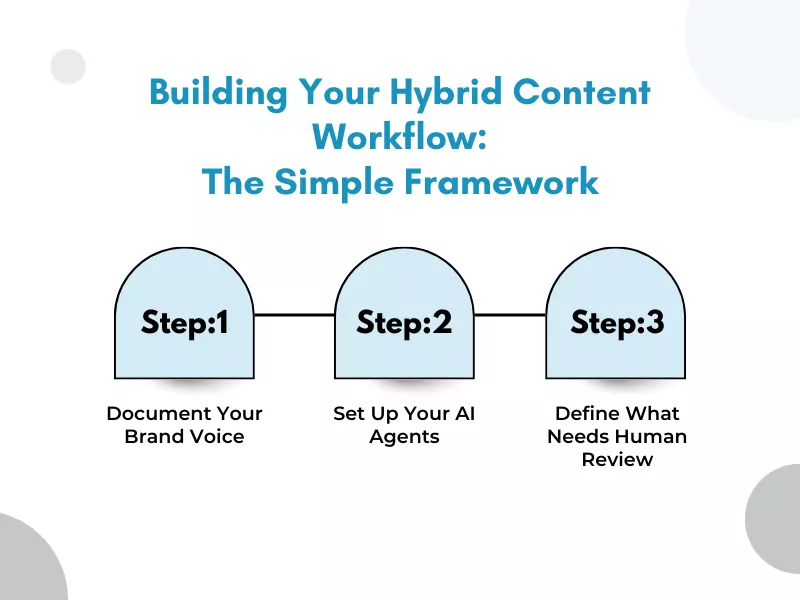
You do not need to understand the AI architecture. You need a clear framework. Here’s how successful teams structure their workflow.
Step:1 Document Your Brand Voice
AI cannot read your mind. You need to teach it how your brand sounds. This means more than saying “be professional” or “be friendly.”
Create a brand voice guide that includes:
- Real examples of your best content
- Words and phrases you always use
- Terms you never use
- How you structure sentences
- Your content’s personality
Step 2: Set Up Your AI Agents
In a human + Agentic AI workflow, different agents handle different tasks. You do not need one super-AI doing everything; you want specialists.
The Research Agent
This agent monitors your industry. It reads news, tracks trends, and identifies topics that your audience cares about.
Every morning, it sends you a list of content ideas with data on search volume and trending discussions.
The Writing Agent
Using your brand voice guide, this agent makes the first draft. It structures content logically, writes in your style, and includes relevant examples.
The SEO Agent
This one optimizes content for search engines. It finds the right keywords, structures headings properly, creates meta descriptions, and suggests internal links. It knows current SEO trends and applies them consistently.
The Quality Agent
Before the content reaches you, this agent checks everything. It verifies facts, makes sure the claims have sources, checks grammar, and confirms the content matches your brand standards.
Step 3: Define What Needs Human Review
Not everything needs your detailed review. Here’s how a smart team decides:
Always human review:
- Content with legal implications
- Executive communications
- Anything addressing controversy
- Original research or thought leadership
Quick human check:
- Standard blog posts
- Customer resources
- Product update
Can publish directly:
- Social media updates
- Newsletter snippets
- Internal documentation
How Do AI Chatbots Compare to Human Agents in Communication Style?

75% customer say chatbots struggle with complex issues. What is the solution? It is not about choosing one over the other; it is knowing what actually works.
Here’s what you need to know:
- AI chatbots cost about 10 cents per interaction and give consistent service.
- Human developers are good at knowing sensitive cultural topics and building trust with customers.
- Cultural differences show that East Asian customers are more comfortable with AI interactions than Western customers.
- Here, the hybrid approach wins where it delivers the best results for multicultural customer bases.
Artificial intelligence chatbots understand cultural communication by understanding patterns and programmed responses. They train the large language models by analyzing texts, understanding communication cues, and generating replies based on that training.
Where AI Chatbots Win?
Uniform Cultural Guidelines
AI chatbots automate the same cultural protocols. It will give you the same response that it gave you on the first day. This helps in creating a uniform response and eliminates the fluctuation in response that comes, and requires minimal human intervention.
24/7 Availability
There are multiple time zones and people need services according to their time zone. AI chatbots are available even at 3 AM. It is helpful for businesses that cater to diverse populations with different cultural expectations.
Shifting Communication Style
Autonomous system can shift the communication style in real-time. For example, an AI agent could switch smoothly between formal legal terminology for law firms and casual conversation for retail businesses. One system can execute multiple audience expectations without human oversight.
Neutral Response
AI chatbots cannot make decisions based on names, accents, or communication style. This automation approach treats each interaction neutrally. These llms unlock personalized intelligent agents specifically for customers’ needs.
Instant updates
When businesses identify new cultural patterns or preferences, AI agentic systems update immediately across all channels. Such instant updates help a lot to take actions promptly.
Tips for Seamless Handoff from AI Chat to Human Agents

1. Know When to Bring in a Real Person
Your AI needs to know when it’s time to get help. If someone’s upset, confused, or dealing with something complicated, the AI should quickly connect them to a human agent. Don’t make people fight to talk to a real person. The best human AI agent setup knows exactly when to make that switch.
2. Share the Full Story
When the AI passes someone to a human agent in AI systems, it needs to share everything. Show the human what the customer already said and what the AI tried to do. Nobody wants to start over from scratch. AI should help the human pick up right where things left off.
3. Tell People What’s Happening
Just say it simply to humming agent ai
4. Help Your Teams Work Together
Your human agents need to understand what the AI does. This way, they can jump into conversations smoothly and build on what the AI started. Think of it as teamwork between humans and AI, not a competition.
5. Let People Pick
Some folks just want to talk to a human right away. Let them. Give them a button to skip the AI if they want. Making everyone go through AI first just annoys people. Your human AI agent system should be flexible.
6. Pay Attention and Improve
Watch when the AI hands off to humans and why. These patterns tell you what’s working and what’s not. Every time your humming agent AI transfers someone, you learn something that makes the system better.
Best Practices for Leveraging AI Agents for Human Resources

Here are the best practices of autonomous AI models for human resources:
Keep Humans in Control
No matter how smart AI gets, you need people watching over it. The best setup is not just having someone check AI’s work after it’s done, it’s having humans actively managing alongside. Your team should be directing what AI does, giving human approval, and setting the rules from start to finish.
Make Sure AI Understands Your Big Goals
Your AI should work like a great employee who gets the bigger picture. Don’t just program it to check off tasks. For example, if you have an AI helping with onboarding, it shouldn’t just make sure new hires finish their training videos. It should help them get everything they need to actually succeed, the right tools, resources, and learning paths to do their job well. Here, human judgment plays an important role.
Check In on Your AI Regularly
Just because AI can work on its own doesn’t mean you should set it and forget it. You need to review what it’s doing on a regular basis. This is especially important when AI makes decisions about people, like hiring, promotions, customer support, or workforce planning. Make sure you can understand why the AI made each decision, not just what it decided. There should be human control over AI solutions.
Teach Everyone How to Work with AI
AI is only useful if your people know how to use it. You need to train everyone on AI basics, just like you’d teach them any other important skill concerning human intentions. This training should be required, ongoing, and available to everyone, whether they’re interns or executives, in sales or operations. Everyone needs to learn how to guide AI agents in real-time and work alongside them effectively.
What Research Shows about Human-AI Teams?
You might wonder: Does working with AI actually make you better at your job? The latest research on Agentic AI at MIT wanted to find out, so they built a platform called Pairit to test it.
They had people create marketing campaigns, write ad copy, make images, and edit headlines. Some people worked with another person. Others worked with AI tools. Here’s what they found:
Human-AI teams were great at writing text. They actually outperformed human-only teams on writing tasks. When they tested the ads on social media, both types of teams did equally well.
How Your Work Process Changes?
Working with AI changes how you spend your time:
- You communicate more (sending more messages back and forth)
- You spend less time editing and more time creating
- You skip the small talk and focus on getting things done
Agentic AI research put it: “You don’t have to build rapport with AI agents. This leads directly to better performance and productivity.”
AI Personality Matters
AI’s “personality” makes a huge difference. The researchers tested different AI personalities, some were open and creative, others were detail-oriented and organized.
What they found:
- Detail-oriented people work better with creative AI development
- Human experts need organized AI to do their best work
- Men and women respond differently to AI personalities
- Different cultures prefer different AI styles
For example, Latin American workers did better with outgoing AI. East Asian workers performed worse with that same style but better with other approaches.
What This Means for You
Don’t just use any AI system. Find one that matches how you work. If you’re detail-focused, look for AI that brings creativity. If you’re naturally creative, you might need AI that keeps you organized.
Human-AI collaboration works, but only when you set it up right. Without human intervention and human feedback, you cannot think of perfect work.
Top Agentic AI Trends to Watch in 2026

Here are the agentic AI trends:
1. AI Built Into Your Software
AI agents are no longer something you add later. They’re built right into the tools you already use. Your software now handles tasks like cutting cloud costs, fixing security issues, and tracking finances on its own. No waiting for you to ask.
2. AI Makes Decisions, Not Just Suggestions
AI isn’t just helping anymore, it’s deciding. Within clear rules, AI agents now analyze options, take action, and learn from results. Human involvement is still in charge, but you focus on the big picture while AI handles the routine stuff.
3. Multiple AI Agents Work Together
Companies now use dozens of AI agents that need to coordinate. Think of it like a control center that manages how different AI agents talk to each other, handle conflicts, and follow company rules. They work as a team, not solo players.
4. Anyone Can Build AI Agents
You don’t need to be a programmer anymore. Low-code platforms let regular business people create their own AI agents. This means the people who actually do the work can build AI that solves their real problems.
5. AI Works on Live Data
The best AI agents run on real-time information. They spot problems as they happen, adjust to changes instantly, and fix issues before they get worse. No more waiting for monthly reports.
6. Humans Still Supervise
More AI autonomy doesn’t mean kicking humans out. Companies are setting up clear rules: AI handles routine decisions on its own, but humans step in for risky, complicated, or strategic choices. It’s about smart oversight, not micromanaging.
7. Different AI Systems Talk to Each Other
Your AI agents need to work across different tools and platforms. Companies are making sure their AI systems can share information and coordinate, even if they come from different vendors. This prevents you from getting locked into one system.
8. AI Cuts Your Cloud Costs Automatically
Instead of just showing you where you’re spending money, AI now actually reduces those costs. It watches your usage, shifts resources around, and enforces spending rules—all without you lifting a finger.
9. AI Handles Compliance and Risk
AI agents now help with the boring but important stuff like following regulations, staying audit-ready, and monitoring risks. Compliance grows with your automation instead of slowing it down.
10. Redesign How You Work
The biggest wins come when you rethink your entire workflow around AI. Let AI agents own complete processes from start to finish. You focus on strategy, handle exceptions, and keep improving the system. This is where real efficiency happens.
The Future Is Already Here
Human + Agentic AI is not some far-reaching future technology. It is working right now for millions of companies. The question is not whether to use it or not; your competitor is already using the applications of agentic AI along with a human workforce. The question is whether you will use it well.
Companies winning this approach share that they did not need a huge budget or technical expertise. And this is what we are saying. You just need clear processes and a willingness to let AI handle what it does best so you can focus on what only humans can do.
Frequently Asked Questions
Does a hybrid workflow mean I’m just an editor now?
No, your role actually becomes more strategic. Instead of spending 60% of your time writing first drafts, you can focus on audience psychology, creative difference, and much more.
How do I maintain my brand voice if an AI agent is running the workflow?
Maintaining brand voice need voice fingerprint. Once it is done, AI maintains the voice consistency better than human teams with high turnover.
Is "Human-in-the-Loop" still the standard for 2026?
This model has transformed to ‘Human-at-the-Helm’. Instead of reviewing everything, you set strategies and just intervene on exceptions. Low-risk content flows directly to publication. Medium risk content triggers only when AI confidence is low. High-risk content always gets human review, but AI handles research and drafts.
Will this hybrid model hurt my SEO or lead to Google penalties?
Google does not penalize AI content; it penalize low quality content without any source. A good workflow produces content which meet Google’s quality standards. The key is combining AI’s research and optimization capabilities with human expertise.
What is "Multi-Agent Orchestration" in content?
Multi-agent orchestration uses AI agents that work together. A research agent gathers information, an analysis agent processes data, a writing agent creates a narrative, a visual agent makes charts, and an SEO agent optimizes it.

