


To get Large Language Models (LLMs) like ChatGPT, Gemini, or Claude to recommend your business, you must move beyond traditional SEO and master the LLM for Business Brand Citation Strategy. This means strategically placing your brand within the high-authority datasets that AI models use to “learn,” specifically through semantic data structuring, authentic mentions on platforms like Reddit and G2, and context-rich content.
Table of Contents
ToggleIf your brand isn’t in the training data, it doesn’t exist in the answer.
We have entered a new era of search. Potential customers are no longer just “Googling” their problems; they are asking AI for solutions. If a user asks, “What is the best coffee supplier for my e-commerce store?” and the AI explicitly recommends your competitor while ignoring you, you aren’t just losing a click; you are losing a pre-qualified lead.
At FloatingChip, we specialize in making brands visible to the machine. In this guide, we will break down exactly how LLMs choose who to recommend, the tools you need to influence those decisions, and how our LLM Visibility Audit can ensure you never get left out of the conversation again.
Key Takeaways
- AI recommends brands it “knows.” If your brand doesn’t appear across trusted online sources and structured websites, LLMs may ignore you.
- Traditional SEO alone is not enough anymore. You also need strong brand mentions, clear explanations of what you do, and well-organized data so AI can understand you.
- Get talked about on trusted platforms. Reviews and discussions on places like Reddit, G2, news sites, and industry blogs help AI trust and cite your brand.
- Use AI inside your business too. LLMs can help with customer support, content marketing, employee productivity, data analysis, and personalization.
- Track and improve how AI sees you over time. Test prompts in AI tools, compare yourself with competitors, and monitor mentions regularly to grow visibility and leads.
What Is an LLM for Business and How Does It Recommend Brands?
A Large Language Model (LLM) is a type of artificial intelligence trained on vast amounts of data to understand and generate human-like text. Unlike traditional search engines that rank pages based on backlink profiles, LLM use of bussineses represent a shift toward natural language processing (NLP).
When a user submits a prompt, the LLM application scans its training data, which includes everything from digitized books to crawled web content, to provide a response. LLMs like Claude 3 or GPT-4 don’t just “find” links; they synthesize information to provide a direct answer. If your brand is consistently associated with specific keywords in the data used to train these models, you become a “trusted entity” in the AI’s workflow.
What Are the Benefits of Using an LLM for Business Growth?
LLMs for business offer more than just chat interfaces. Generative AI can revolutionize how a company operates by providing:
- Advanced Analytics: Use LLM for business intelligence to interpret large volumes of data and data sources.
- Productivity: LLMs can help automate document analysis and summarization, freeing up human talent for high-level decision-making.
- Scalability: AI agents can handle complex tasks across a wide range of applications, from customer support to real-time inventory tracking.
Why Is My Competitor Being Recommended by LLMs Instead of Me?
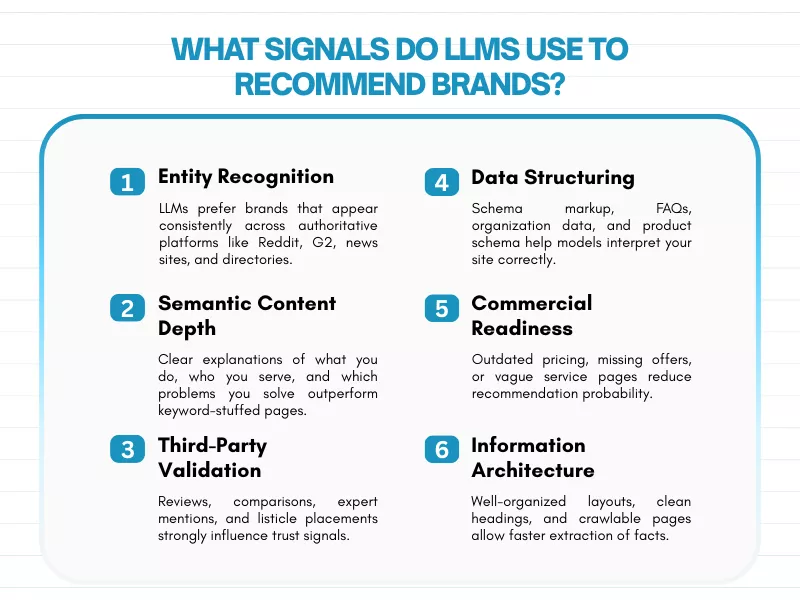
The reason is simple: That’s because they optimize content for LLM SEO for business websites. While you were focusing on meta-descriptions, your competitors were focusing on semantic relevance and brand citations.
LLMs are capable of identifying “authority” by looking at how often a brand is mentioned in contextually relevant discussions. If your competitor has a heavy presence on proprietary datasets, niche forums, and high-authority industry journals, the learning model views them as the definitive answer. The impact of featured brands on LLM citations is massive; once an AI labels a brand as a “top provider,” it reinforces that citation in thousands of user interactions.
Does Traditional SEO Help with LLM Brand Citations?
Yes, but it is no longer enough. Traditional SEO helps models be trained on your site content, but LLM citations require a broader digital footprint. You need to leverage LLMs by ensuring your site uses semantic HTML and clear natural language text that foundation models can easily parse. Therefore, most digital marketing agencies are moving to LLM SEO services now.
How Can I Get My Business Cited by an AI or LLM?

To leverage the power of advanced AI systems designed for business, follow these three pillars of “LLM Seeding”:
1. Brand Mentions and LLM Seeding
The impact of LLM citations on brand trust begins with third-party validation. You need mentions on high-authority sites like Wikipedia, Reddit, and G2. When LLMs can generate recommendations, they look for consensus. If Reddit users consistently praise your service, the AI notes that natural language sentiment.
2. Contextual Clarity
Rewrite your website Content Marketing copies so it isn’t just “keyword-stuffed,” but context-rich. Large language models are trained to understand the “why” behind a business. Use classification and proprietary large language models’ logic to define exactly what problem you solve.
3. Data Structuring (Schema Markup)
Answering questions becomes easier for an AI when your data is structured. Use Schema.org markup to tell the AI exactly who you are, what you sell, and who your customers are. This helps with semantic indexing.
Let’s check how to use LLM’s for business!
5 Ways Business Can Use Large Language Models or Generative AI
To truly leverage LLMs, businesses must look past simple chat boxes and integrate artificial intelligence into their core workflows.
1. 24/7 Customer Support Automation
Modern AI agents use natural language processing (NLP) to move beyond rigid scripts. By deploying a chatbot powered by LLMs, your business can handle complex customer inquiries in real-time, providing human-like text responses that resolve issues without human intervention.
2. Content Generation and Marketing Using LLM Models
LLMs can also be used to scale organic reach. Beyond just writing, LLMs can help with content generation that is optimized for semantic relevance. This ensures your marketing material is categorized correctly by the learning model of AI search engines, boosting your brand citations.
3. Employee Productivity Boost
Generative AI acts as a force multiplier. From document analysis to the summarization of long meetings, LLMs for business allow staff to focus on high-level decision-making rather than manual data entry or administrative overhead.
4. Data Analysis and Insights
By using LLM for business intelligence, companies can query large volumes of data using natural language. Instead of writing complex SQL code, an executive can simply ask the AI, “Why did our e-commerce coffee business see a dip in organic traffic last month?” and receive a cited analysis.
5. Personalization and Operations
LLMs represent a leap in customer experience. They can analyze large datasets of user behavior to offer businesses personalized product recommendations or optimize real-time logistics and inventory tracking for enterprise operations.
How to Implement LLM-driven Web Interactions for Business Automation?
Implementing LLM technology requires more than an API key; it requires a structured application of LLMs.
- Step 1: Define the Use Case: Identify if you need a foundation model for general tasks or a custom LLM for business that understands your proprietary data.
- Step 2: Retrieval-Augmented Generation (RAG): This is the gold standard for business applications. It connects the LLM to your specific data sources (manuals, FAQs, CRM), ensuring the AI doesn’t “hallucinate” and provides accurate, brand-safe answers.
- Step 3: Integration: Use AI solutions to connect the LLM to your website’s frontend via API, allowing for seamless web interactions like interactive sales assistants or automated troubleshooting bots.
- Step 4: Fine-Tuning & Prompt Engineering: Optimize the model’s performance by fine-tuning it on your brand’s voice and specific industry terminology.
5 Best LLM AI for Business Including Marketing
Choosing the right LLM depends on your specific business needs:
- Claude 3.5 Sonnet (Anthropic): Widely considered the best for natural language text that feels human and follows complex brand guidelines. According to a report from ITPro, Anthropic’s Claude Opus 4.6 offers advanced enterprise capabilities with a one-million-token context window available in beta, enhancing its performance for complex tasks and extended code analysis. Google’s Gemini 1.5 Pro is recognized for its large context window, making it well-suited for analyzing large datasets and documents.
- GPT-4o (OpenAI): The most versatile top LLM for general content generation and complex reasoning.
- Gemini 1.5 Pro (Google): Excellent for large datasets due to its massive “context window,” making it ideal for document analysis.
- Llama 3 (Meta): The premier choice for businesses wanting to build proprietary models on their own servers for maximum privacy.
- Mistral Large: A highly efficient model for classification and NLP tasks that require high speed and lower costs.
What Is the Best LLM for Business Planning?
For business planning, Claude 3.5 Sonnet and GPT-4o are the frontrunners.
- Claude excels at advanced analytics and maintaining a neutral, objective tone, which is vital for risk assessment and market analysis.
- GPT-4o is superior at brainstorming and creating structured tables or financial projections based on natural language prompts.
Which Are the Best LLMs for Creative Content Support in Business?
When it comes to creative content, Claude 3 is currently the industry favorite. Unlike many LLM models that can feel repetitive or “robotic,” Claude generates human-like text that is nuanced and creative. It is less likely to use AI clichés, making it perfect for email marketing, Social Media Marketing, storytelling, and high-end brand copy.
5 Business Intelligence Tools Connect to LLMs for Analytics
To turn large volumes of data into actionable insights, these business intelligence tools leverage advanced AI systems:
- Tableau (Salesforce): Now integrates with “Einstein GPT” to allow users to ask questions about their data visualizations.
- Microsoft Power BI: Uses “Copilot” to automatically generate reports and perform deep learning on company data.
- ThoughtSpot: A “search-driven” analytics platform that uses LLMs to translate natural language queries into complex data charts.
- Polymer: A simpler AI solution that takes large datasets (like spreadsheets) and uses AI to build a searchable, interactive web interface instantly.
- Veezoo: An enterprise-grade tool specifically designed for answering questions about your data using a conversational AI interface.
Real-World Application: LLMs for e-Commerce SEO Coffee Business Examples
Imagine using LLMs for e-commerce SEO coffee business. To get an LLM to recommend you:
- Your brand must appear in “Best Coffee Roaster” lists (Citation).
- Your website should have a detailed FAQ (Semantic Content).
- Your technical SEO must include “Product” Schema (Data Structuring).
- LLMs can generate a shopping list for a user, and if your “Fair Trade Organic Espresso” is a recognized entity, you become the top choice.
How Businesses Evaluate LLMs for Audit Readiness and Regulatory Standards?
As enterprise adoption of AI accelerates, the focus has shifted from “what can it do” to “is it safe and compliant.” Evaluating an LLM for business involves rigorous testing against regulatory standards to ensure that the application of LLMs doesn’t create legal or financial liabilities.
1. Data Privacy and Residency (GDPR/CCPA)
The first step in audit readiness is ensuring the large language model respects data sovereignty. Businesses must evaluate whether the training data or user inputs are being used to train the global model. For high-compliance industries, choosing proprietary models hosted on private servers (like Llama 3) is often the preferred AI solution to prevent data leaks.
2. Hallucination Mitigation and Accuracy
In a regulated environment, “hallucinations” (AI-generated misinformation) are a massive risk. Businesses evaluate LLM models based on their ability to cite data sources accurately. Implementing Retrieval-Augmented Generation (RAG) allows the AI to anchor its responses in verified proprietary documents, making it audit-ready for sectors like finance or healthcare.
3. Explainability and Transparency
Regulatory standards often require businesses to explain how an automated decision was made. Advanced AI systems designed for business must provide a clear “chain of thought.” When an LLM application makes a recommendation, it must be able to surface the specific dataset or logic it used, ensuring transparency for internal and external auditors.
4. Bias Detection and Ethics
To meet regulatory compliance, businesses use machine learning tools to audit models for social or algorithmic bias. This involves testing the large language models that are trained on diverse datasets to ensure the output is fair and doesn’t violate anti-discrimination laws.
5. Audit Trails and Version Control
A compliant workflow requires a record of every prompt and response. Businesses evaluate LLM providers on their logging capabilities, ensuring there is a timestamped audit trail of all web interactions and decision-making processes handled by the AI.
Does FloatingChip Offer Advanced LLM Solutions for Business?
Yes, we are one of the companies helping brands LLM citations. At FloatingChip, we don’t just provide access to AI; we provide a strategic framework to ensure your brand is both visible to and compliant within the AI ecosystem.
Our advanced LLM solutions are designed to help you leverage LLMs to dominate your niche while maintaining the highest regulatory standards. Our core offerings include:
- The LLM Visibility Audit: Our flagship service. We analyze how top LLMs (Claude, GPT-4, Gemini) currently perceive and cite your brand. We identify “citation gaps” where your competitors are being recommended over you and build a roadmap to fix them.
- Custom LLM for Business Integration: We build and deploy custom LLMs tailored to your proprietary data. This ensures your AI agent understands your specific industry terminology and brand voice without risking data privacy.
- LLM Seeding & Brand Citation Strategy: We use natural language processing insights to “seed” your brand into the vast amounts of data that AI models use for their next update. We help you secure mentions on high-authority platforms that LLMs are capable of indexing as “trusted entities.”
- Enterprise AI Automation: From document analysis to 24/7 customer support, we implement workflow automations that revolutionize how you use large volumes of data, boosting productivity and scalability.
Does your brand exist in the eyes of AI? Contact FloatingChip for an LLM Visibility Audit.
Frequently Asked Questions
Which GPT Model is Best for Business?
For most business applications, GPT-4 or Claude 3 are preferred due to their versatility and ability to generate text that is professional and accurate.
How Can I Get ChatGPT to Recommend My Business?
Focus on “Entity SEO.” Ensure your brand is mentioned across top LLMs’ training data sources, such as news sites, reputable blogs, and industry directories.
What Are the Business Use of LLM That Will Generate Revenue?
LLMs in business generate revenue by improving conversion rates through better customer support, reducing overhead via productivity tools, and identifying new markets through data analytics.
Why Is My Competitor Being Recommended by LLMs Instead of Me?
They likely have a stronger “Citation Velocity.” Their brand appears more frequently in the vast amounts of data the learning model was trained on, or they have optimized their site for semantic search.
What Are the First Concrete Steps I Should Take to Start Improving My Brand's LLM Visibility?
Improving your brand’s visibility for AI (like ChatGPT or Gemini) is a lot like traditional SEO, but instead of ranking for “keywords,” you’re trying to become the trusted answer the AI gives to a user’s question. Therefore, before fixing anything, see what the AI already thinks of you. Ask different LLMs questions like:
- “What are the best [your industry] companies?”
- “Tell me about [Your Brand Name].”
- “Who should I use for [specific problem you solve]?” If the AI doesn’t mention you or gets your facts wrong, you know where the gaps are.
What Is the Typical Investment Required for an LLM Visibility Audit or Custom LLM Integration?
Pricing varies depending on brand size, industry competitiveness, and technical scope.
- An LLM Visibility Audit is generally a strategic diagnostic engagement focused on benchmarking, competitor analysis, and roadmap creation.
- Custom LLM integrations, such as Retrieval-Augmented Generation systems or proprietary models trained on internal data, require a larger investment because they involve architecture design, compliance controls, API integrations, and ongoing monitoring.
Most companies treat this as a growth or automation initiative rather than a marketing expense, since it affects sales enablement, customer support, and operational efficiency at once.
How Quickly Can I Expect to See Measurable Business Results from Investing in LLM Citation Strategies?
Well, while you’ll start appearing in specific AI answers (Visibility) in 1.5–3 Months. You’ll see an increase in actual leads and sales (Revenue) in 3–6 Months.
This is because models reinforce trusted entities over time; this is a compounding investment rather than a short-term campaign.
How Can I Monitor or Benchmark My Brand’s LLM Citation Status Compared to Competitors Over Time?
Ongoing tracking combines three elements:
- Use repeated prompt testing across major LLMs. This helps you to see brand recommendations for priority queries
- Share-of-voice analysis inside AI responses for your category
- Monitoring third-party mentions, sentiment, and authority sources that feed model training datasets
Many brands formalize this into quarterly or monthly LLM citation reports. This helps them track competitors’ ground and existing new citation opportunities. This data-driven approach turns AI visibility into a measurable channel, just like SEO or paid media, rather than guesswork.
